
Exotic Organic Farm
Coimbatore, India
Two rare Japanese maples, one listing: ‘Orange Dream’ with glowing golden-orange leaves and the laceleaf ‘Orangeola’ with finely cut orange-red foliage. A graceful, slow-growing specimen for pots, courtyards and shaded gardens.
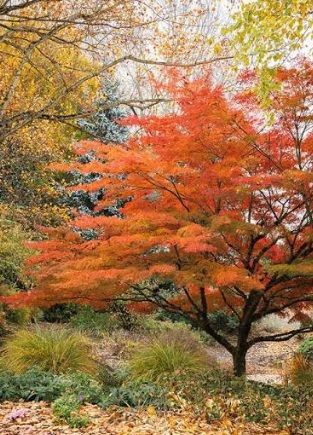
Rare Japanese mapleTwo hard-to-find cultivars, not common nursery stock.
Sold by a Coimbatore farmExotic Organic Farm, Kuppanur, Coimbatore.
Honest climate adviceCare notes written for Indian heat, monsoon and humidity.
Live plant, WhatsApp supportAsk us anything before and after you order.
Acer palmatum, the Japanese maple, is native to Japan, Korea and China, where it grows as a small understorey tree in cool, shaded woodland. Centuries of selection in Japan have produced hundreds of named cultivars, prized for their delicate leaves and shifting seasonal colour.
‘Orange Dream’ is an upright cultivar whose spring leaves open golden-yellow edged in orange, mellow to lime-green in summer, and turn warm golden-orange in autumn. Its young stems are tinged red. ‘Orangeola’ is a laceleaf (dissectum) maple with finely cut leaves that open in glowing orange-red and bronze tones, turn green with orange hints in summer, and finish in fiery orange-red in autumn, on a soft, cascading, mounded form.
| Botanical name | Acer palmatum ‘Orange Dream’ and Acer palmatum ‘Orangeola’ |
| Common name | Japanese maple; ‘Orangeola’ is a laceleaf (dissectum) maple |
| Native to | Japan, Korea and China (species); cultivars selected in Japan |
| Plant type | Deciduous ornamental tree |
| Habit | ‘Orange Dream’ upright and compact; ‘Orangeola’ cascading mound |
| Mature size | Slow-growing; typically 1.5–3 m, smaller when container grown |
| Foliage | Golden-orange (‘Orange Dream’); finely cut orange-red to bronze (‘Orangeola’) |
| Flowering | Small red-purple flowers in spring; rare and unremarkable in India |
| Light | Bright filtered light; morning sun, shade from harsh afternoon sun |
| Temperature | Prefers cool to moderate climates; needs shade and cool roots in hot weather |
| Difficulty in India | Moderate to challenging in hot plains; easier in cooler regions |
Japanese maples are cool-climate trees, so Indian heat is the main challenge. These are general guidelines; adjust to your city, balcony and season, and message us if you want advice for your location.
Give bright filtered light or morning sun. Shade it from hot afternoon sun, which scorches the leaf edges, especially on the fine laceleaf ‘Orangeola’.
Keep the soil consistently moist but never waterlogged. A potted tree may need water every day or two in peak summer, and much less in monsoon and cooler months.
Use a rich, free-draining mix of cocopeat, garden soil, compost and perlite or coarse sand, in a large pot with drainage holes.
Mulch the surface and keep the pot out of direct heat. Group it with other plants or place it on a shaded, sheltered balcony or courtyard.
Feed a balanced liquid fertiliser at half strength during active growth. Avoid heavy feeding in hot spells, and never feed a stressed tree.
Hot, dry wind dries the delicate leaves. Choose a protected spot, and expect some leaf drop in extreme heat; healthy plants recover.
It flowers, but the blooms are tiny red-purple clusters in spring and are not the point of this tree. The real show is the foliage: vivid new growth in spring, and warm autumn tones where nights turn cool. In hot plains, expect good spring colour but a muted or absent autumn change, and possibly some leaf drop in peak heat. Cooler regions give the strongest seasonal display.
Japanese Maple · view 1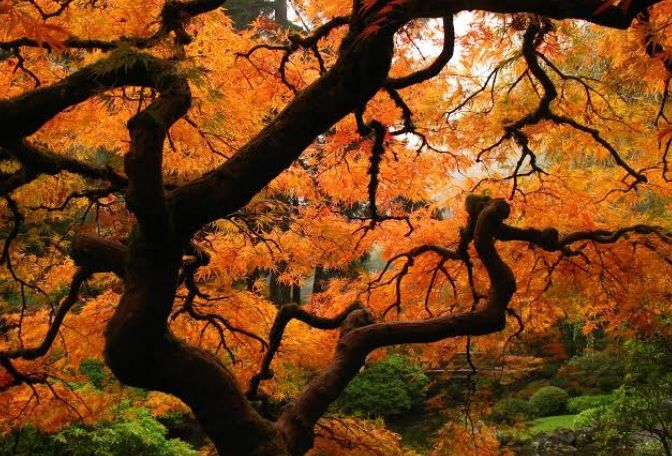 Japanese Maple · view 2
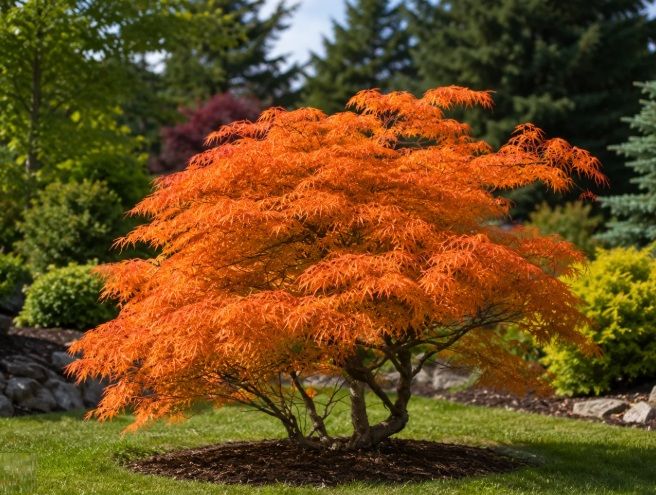 Japanese Maple · view 3
Orange Dream is an upright Japanese maple with golden-yellow spring leaves edged in orange, growing as a small, tidy tree. Orangeola is a laceleaf (dissectum) maple with finely cut orange-red to bronze foliage and a soft, cascading, mounded habit. Both are Acer palmatum cultivars.
Japanese maples prefer cool climates, so in hot plains they need care. Grow them in a large pot in bright filtered light with shade from harsh afternoon sun, and keep the roots cool and evenly moist. Cooler hill-station climates suit them best. Message us with your city and we will advise honestly.
Strong autumn colour needs cool nights, which most Indian cities do not have. You can still enjoy the vivid new spring growth, and in cooler regions the autumn tones are better. Warm-climate plants may lose leaves or rest for a period, which is normal.
Yes. Both cultivars are slow-growing and do well in a large container with good drainage. Choose a spot with morning sun or bright filtered light and shelter from hot wind and harsh afternoon sun.
Keep the soil evenly moist but never waterlogged. In hot weather that can mean watering every day or two for a potted tree; reduce in monsoon and cooler months. Check that the top 2-3 cm is just starting to dry first.
Yes. Acer palmatum 'Orange Dream' and 'Orangeola' are rare in Indian nurseries and we usually hold limited stock. Message us on WhatsApp to confirm current availability and which cultivar is ready before ordering.
Live trees are packed carefully and shipped from our Coimbatore farm. Message us your pin code and we will confirm the packing and delivery time for your location.
Yes, but the flowers are small and easy to miss. In spring it carries clusters of tiny red-purple flowers, which can be followed by winged seeds (samaras). The real attraction is the coloured foliage, which flowers rarely overshadow in Indian conditions.
Looking for the Japanese maple price in India, where to buy Japanese maple online, or Acer palmatum Orange Dream and Orangeola care tips? This page covers all three. Japanese Maple is one of the rare ornamental trees for sale in India at exoticfarm.in, from Exotic Organic Farm in Coimbatore, with delivery to Chennai, Bengaluru, Kerala and the rest of India (message us to confirm for your pin code).
₹3,500 · Flowering tree
₹2,500 · Flowering tree
₹2,500 · Flowering tree
₹2,500 · Violet-blue flowering tree
Rare live plants: bat flower, water lily, bottlebrush and more.